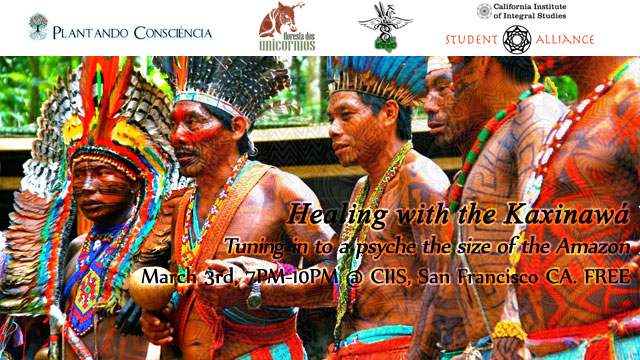
Healing with the Kaxinawa
Tuning in to a Psyche the size of the Amazon.
Come to join us for this FREE workshop hosted by Nicole Roitberg, a Brazilian anthropologist, Leopardo Yawabane, a native tribal healer from the Amazon, and Marcelo Schenberg, the executive director of Plantando Consciencia, who will introduce us to the indigenous cosmology and healing practices of the Kaxinawa people of Brazil, at the California Institute of Integral Studies in San Francisco. The event is presented through a partnership between Plantando Consciência and FLOU institute from Sao Paulo, and San Francisco based Erie (Entheogenic Research, Integration, and Education).
The Kaxinawa or Huni Kuin people, in their language, are a tribal ethnicity of indigenous natives that inhabit the Brazilian-Peruvian border in the state of Acre, northwest of Brazil, spread out along the rivers that flow in the depths of the Amazon forest.
Having resisted and survived the developmental frenzy of the 70s and 80s and the rubber tapping boom that forcefully colonized part of their land - causing quite a damage among their people - since the 1990s the Huni Kuin have been working hard on rescuing their roots, a tradition whose wisdom our planetary culture is increasingly yearning for.
The Huni Kuin descend from an ancient lineage that has been revering the Earth for centuries. They embody what psychologist James Hillman called “a Psyche the size of the Earth”. Their people bear close ties to the earthbody in ways most westerners can’t even conceive today. Through their cosmology, customs, and traditional rites and language, they maintain an inextricable link with the forest, with which they constitute a whole – an organism whose psyche is as afflicted as ours in critical times such as these.
Most native peoples with animistic belief systems understand health as an integrated whole, involving a web of complex relations which include, among other things, a selfhood connected to his/her particular land and nature, grounded on the sacred experience that permeates all life.
Moreover, besides the planetary stature of their system of health and healing, which shares commonalities with better known shamanic traditions from South America (such as the mestizo curanderismo from Peru), the tribal society differs from the mestizo tradition in that their life is entirely centered around the community.
The aim of this workshop is to present an representative of the Huni Kuin tradition, along with his co-worker and translator, to introduce the Amazonian cosmology to CIIS students, alumni, faculty, and general audience. During the event, our presenters will summarize the history and culture of the Kaxinawa tradition, paying special attention to their perspective on integral health and how their relationship with the material world – alive not only in plants and animals, but in minerals, fire, water and air – is interwoven with their understanding of self: a greater self that is all encompassing and whose wisdom is a priceless source of inspiration for us today.
This event can be instrumental for students from a range of distinct programs, such as Philosophy, Cosmology and Consciousness (by offering an living example of ecocosmology), East-West Psychology (as an authentic expression of south american shamanism), Somatic Psychology, Drama-Therapy and Clinical Psychology (by offering a practical model for integrating psychotheraphy, ritual and spirituality), Community Mental Health (by offering a vision of health and healing that is inseparable from the notions of relationship and community), Expressive Arts Therapy (through their expressive arts interventions: the dances and drawing of the sacred kenes), and Anthropology and Social Change (lessons from a unique form of postcolonialist resistance movement).
About us:
Marcelo Schenberg is the executive director of Plantando Consciência, a multidisciplinary non-profit organization dedicated to entheogenic literacy and research. He’s currently a PCC master’s student at CIIS and is directing and producing the documentary film Medicina, a journey into shamanic medicine and beyond. Learn about the film here.
Leopardo Yawabane was born on the Kaxinawá Reserve of Rio Jordão (Jordão river), in the state of Acre, Brasil. He began to participate in ceremonies with plant medicine within his tribe since he was 8 years old, learning from the pajés (shamans) and leaders in the region. In 2003 he moved to São Paulo to study the Portuguese language and, more recently, sociology/anthropology. Bearing the intention of becoming a future political leader of his people, he set out to live in the city in order to have a better understanding of western society and thus learn how to better channel the indigenous needs in today’s ever changing world.
Yawabane has been conducting healing ceremonies and retreats with special shamanic diets for the past 10 years, in various cities in Brazil and in South Africa. He gives talks in schools and at cultural institutions, sharing the traditions of his people and the history of Indians in Brazil. He is the vice-president of the Institute of Indigenous Traditions. For the past 6 years he has created a special partnership with FLOU Institute, in São Paulo, conducting cultural and shamanic workshops and healing circles.
Nicole Roitberg is the co-founder and coordinator of FLOU Insitute, cultural anthropologist by Bryn Mawr College, sustainability consultant, environmental and transdisciplinary educator by UNIPAZ (University of Peace). She promotes educational programs for sustainable living and organizes and assists Yawabane and other indigenous healers in their traditional healing circles, helping bridge Western and Shamanic traditions with the goal of enabling people to become participants in healing themselves and their communities in the face of the greater needs of the Earth.
FLOU Institute is dedicated to inspiring change and creating a paradigm of sustainable living through projects and programs involving four areas: biocentric sustainable education, multicultural events, spirituality and ancestral medicine, and bioconservation. Since 2007, and in joint effort with native representatives and leaders, FLOU institute has helped organize and support practices of native peoples through the creation of cultural workshops, therapeutic shamanic circles and healing ceremonies. Learn more about FLOU and its work by visiting this link: www.florestadosunicornios.com.br/medicinas-da-floresta/ancestral-medicine-and-integral-health/.
ERIE was founded by graduate students at the California Institute of Integral Studies (CIIS) in San Francisco. ERIE members conduct research on entheogens; host peer integration circles for those seeking to comprehend and incorporate complex and challenging transpersonal experiences into their lives; and sponsor lectures, panel discussions, conferences, and round table dialogues to educate the public about the potential of entheogenic medicines, natural and synthetic, to promote personal growth and social healing; thus helping to dispel misinformation about psychedelics. Learn more about ERIE and its work by visiting this link: http://erievision.org/
Share this post on